
1. The Nile River as Egypt's Main Transportation Route
The Nile River was the most important element of Ancient Egypt transportation. Because Egypt developed along a long, narrow river valley, water travel provided one of the easiest and most efficient ways to move people and goods.
The Nile connected Upper Egypt in the south with Lower Egypt in the north.
Traveling downstream toward the Mediterranean was generally easier because the river naturally flowed northward.
Traveling south required boats to work against the current. Fortunately, prevailing winds often blew from the north, allowing sailing vessels to travel southward using sails.
This combination of river current and wind made the Nile exceptionally useful as a transportation system.
Egyptians transported agricultural products, stone, timber, pottery, grain, livestock, and other goods by boat.
Passengers also traveled along the river.
Government officials, priests, merchants, soldiers, and ordinary people could use boats for different purposes.
The Nile was particularly important for transporting massive building materials.
Large blocks of stone could be loaded onto barges and moved from quarries toward construction sites.
This was essential for monumental projects such as temples, pyramids, statues, and obelisks.
The river also supported communication between different Egyptian communities.
Instead of traveling long distances over difficult desert terrain, people could often use the river as a natural highway.
Ports, docks, and landing places developed along the river.
These locations allowed goods to be transferred between boats and land transportation.
The Nile therefore functioned as more than a source of water and agriculture.
It was the main transportation corridor of ancient Egyptian civilization.
Without the Nile, moving people and heavy materials across Egypt would have been significantly more difficult.
The river’s importance explains why boats appear so frequently in Egyptian art, tombs, temples, and archaeological discoveries.
2. Ancient Egyptian Boats and Ships
Boats were at the heart of Ancient Egypt transportation. Egyptian shipbuilders developed many types of vessels for different purposes, including fishing, transportation, trade, military operations, and religious ceremonies.
Early Egyptian boats were commonly made from papyrus reeds, which were abundant along the Nile.
Papyrus boats were lightweight and useful for fishing, hunting, and traveling through shallow waters.
As Egyptian shipbuilding developed, larger vessels were constructed from wood.
Wood was not abundant in Egypt, so high-quality timber often had to be imported from regions such as the Levant.
Egyptians used wooden boats to transport cargo and passengers along the Nile.
Some ships were designed specifically for carrying heavy materials.
Large cargo vessels could transport stone blocks, grain, and other heavy goods.
The discovery of the Khufu ship provides remarkable evidence of Egyptian shipbuilding during the Old Kingdom.
The vessel, associated with the Great Pyramid complex at Giza, demonstrates the advanced woodworking and construction skills available to Egyptian craftsmen.
Egyptian boats commonly used oars for maneuvering and sails for longer journeys.
The square sail was particularly useful when favorable winds were available.
Sailing southward against the river current could be achieved by using the prevailing northern winds.
Boats were also important for religious activities.
Temples possessed ceremonial vessels, and religious processions sometimes involved transporting sacred images by boat.
Funerary traditions also included boats. Egyptians believed that boats could play an important role in the journey of the deceased in the afterlife.
Royal expeditions used larger ships to travel beyond Egypt.
Trade and diplomatic missions required vessels capable of navigating the Mediterranean and Red Sea.
Egyptian shipbuilding therefore supported almost every major aspect of civilization.
The development of different boat designs demonstrates the importance of adapting transportation technology to specific purposes.
3. Donkeys and Pack Animals in Ancient Egypt
Donkeys were among the most useful forms of land transportation in Ancient Egypt. They were especially valuable for carrying goods through villages, agricultural areas, and desert routes.
Unlike wheeled vehicles, donkeys could travel along narrow or uneven paths.
They required relatively little food compared with larger animals and were well suited to Egypt’s dry environment.
Farmers used donkeys to transport agricultural products.
Merchants could load goods onto pack animals and travel between settlements and trading centers.
Donkeys were also important for transporting supplies during desert expeditions.
Egyptians traveled into desert regions to obtain valuable resources such as gold, stone, copper, and other minerals.
Pack animals helped carry water, food, tools, and extracted materials.
Donkeys could also transport goods between the Nile Valley and nearby oases.
Their importance is reflected in Egyptian art, inscriptions, and archaeological evidence.
Other animals also had transportation roles.
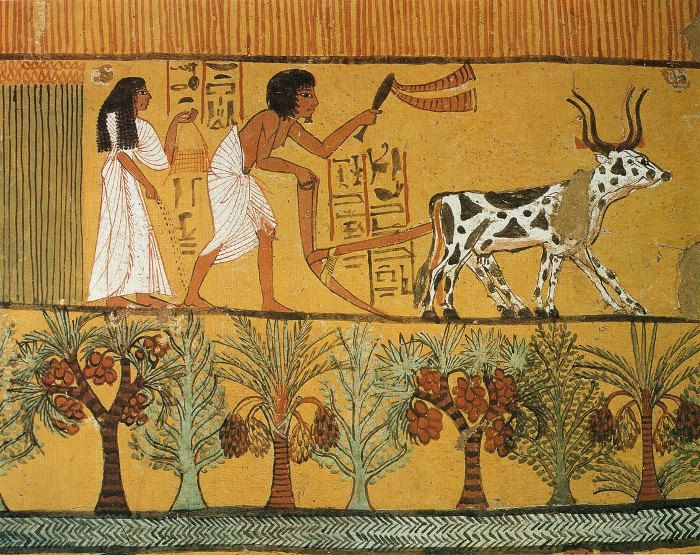
Oxen were frequently used for agricultural work and could pull sledges or other heavy loads.
Cattle were valuable for farming and could contribute to the movement of heavy materials.
Horses became particularly important later in Egyptian history, especially after the introduction of the horse-drawn chariot.
Camels were not a major transportation animal during most of pharaonic Egyptian history. Their widespread use in Egyptian transportation became much more important in later periods.
The donkey therefore remained one of the most practical and versatile animals in ancient Egyptian daily life.
Its ability to carry substantial loads made it particularly valuable where roads were rough or nonexistent.
For ordinary transportation, donkeys were often more practical than expensive wheeled vehicles.
Their widespread use demonstrates that transportation technology did not always depend on complex machinery.
A well-adapted animal could provide an extremely effective transportation solution for both everyday life and long-distance travel.